
Premature Babies Need a Special Kind of Touch
We know how important it is to hold our babies close, right from the start. We put a lot of planning into those first few hours and weeks, arranging to avoid the interruptions that would unnecessarily deprive our babies of those precious moments of bonding time.
When a baby arrives into the world long before she is expected, the best-laid plans are obliterated. The quiet, warm, joyous welcome hoped for is abruptly replaced by a kind of violence we never imagined. It is an unavoidable violence, one that keeps the baby alive but also engenders a tremendous range of feelings and reactions in parents.
Parents are thrust into cycles of grief, shock, denial, guilt, anger, depression, bargaining, and fear. These feelings and many variations on them are natural and may recur in cycles for a long time after the baby’s birth. Parents recover from the initial shock at different rates; most finally do accept the situation and try to find ways to help their baby through it and initiate the bonding process.
What about the premature baby? Thrust into cycles of her own — shock, pain, fear, withdrawal — she may be ignored as an emotional, feeling human being while the adults around her focus on saving her life. This kind of treatment sometimes extends far beyond what is necessary, objectifying the baby and pushing an emotional wedge between her and her parents — between her and the world.
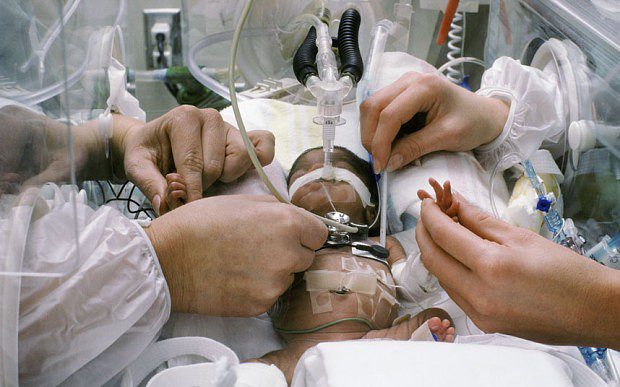
The preemie’s first contact with human touch may bring pain — needles, probes, tubes, rough handling, bright lights — suddenly, after the warm protection of the womb. One of the first things parents can do to help and to begin bonding is to touch and hold their baby. This wonderful expression of caring contributes to both physical and psychological healing, not only for babies but for parents, too. Much of the anguish of those first days and weeks can be minimized if parents can feel some sense of control.
Many studies have proven that premature babies who are regularly touched and who regularly hear their parents’ voices during their nursery stay improve rapidly in growth and development. Judith Talaba, head nurse in a neonatal intensive care unit, has introduced holding methods and massage as a regular part of every baby’s routine; many hospitals around the world do this now as a matter of course.
“Massage gives parents a focus on the baby as an individual who needs her parents just as much as she needs the technology. Parents in our nursery have become less concerned with oxygen concentrations, weight gain, and intake amounts, and more concerned about their infants being touched and massaged — a wonderful change of focus.”
Judith Talaba, Head Nurse, Neonatal Intensive Care Unit
Preemies in the NICU have responded positively to massage, Talaba adds, losing their hyperflexia (contraction of the body) and withdrawing-from-touch behaviors. Many have also had fewer apnea (cessation of breathing) spells.
Preemies in the Hospital
Preemies love the feeling of enclosure that a pair of warm, loving hands can give. But it is important to go very slowly, very tenderly. Look around your baby’s environment. What changes might be made to help your baby relax and feel more comfortable, less invaded? Sometimes a small change in light, sounds, or handling can make a big difference.
Managing Light
A certain amount of light is necessary for nurses to observe the baby, but most nurseries will allow you to shade the baby’s sensitive eyes. If your child is on a warming table, you can shield her head with an overturned box — such as a diaper box — with holes cut in all sides. In an incubator, a folded towel on top will do the trick. When the baby has stabilized, you can request that the incubator be shaded at night to help your baby regulate to cycles of day and night.
Managing Noise
For a stark example of how our society objectifies infants, observe an adult intensive care unit and then a neonatal unit. The adult area is calm and quiet. But often babies are subjected to loud conversation, ringing telephones, and rock music. Additional noise may include the high decibel levels of incubator monitors, the clatter of instruments and clipboards, and the slamming of incubator doors.
You can ask nursery staff to lower the tone of conversation and music. You can fasten a sign on the incubator requesting gentle closing, and place a towel on top to dampen the clang of instruments.
Comforting Sounds
Sounds that help your baby feel more comfortable can be introduced. Premature babies, like all babies, are soothed by their mother’s voice and heartbeat sounds. When you are unable to be present, a heartbeat soother (available at many baby stores and through catalogs) may be introduced and, at intervals, a recording of your voice. First check it out with your baby — be sure the volume is low and not distressing. When you are there, talk and sing to her. Even if she doesn’t seem to respond, she is listening. She remembers your voice, and it soothes her.
Learning to Read Your Baby’s Cues
Your little one’s first reactions to handling may be distressing. Go slowly, watch, listen, and learn from her and from sensitive hospital staff. A preemie’s distress signals — which include apnea (cessation of breathing) and bradycardia (reduced heart rate) — can instill so much fear that you may find yourself making excuses not to handle her.
Not surprisingly, studies show that parents are the ones who are best able to reduce their preemies’ distress. Breathe deeply, relax, and move through these moments with your baby. Assure her that she is okay, that you are here to love and care for her no matter what happens. Your baby needs to feel your strength and confidence.
Observe your infant’s alertness cycles to decide when the best time may be for the pre-massage techniques discussed in this chapter. Discover what kinds of stimulation she can handle. Some babies are extremely fragile and can cope with only one modality at a time — touching, talking, or eye contact, but not all three at once. Find out what kinds of drugs your baby has been given. Some — such as curare and Pavulon — will make her unresponsive. Even then, your baby is aware of you, can feel and hear you, and needs your loving touch.
Infant Massage in the NICU
The International Association of Infant Massage (IAIM) is the world leader in nurturing touch, primarily due to its focus on observing cues that are in alignment with a baby’s ability to receive touch. IAIM has pioneered and refined touch concepts over decades through working with professionals in many cultures globally.
Through their cues, preemies tell you what kind of touch they are able to receive at any given moment. While research conducted by Tiffany Field at the Touch Research Institute in Miami showed good outcomes from massaging babies in the NICU, holding techniques — communication through touch — are generally considered better suited to premature babies, with actual massage techniques more appropriate once the baby is home.
IAIM now has strict policies about working with parents in the NICU, as several instructor trainers, with help from NICU nurses, noticed that preemies were exhibiting cues of overstimulation when massaged. One review concludes that while there seems to be an increase in weight gain in infants receiving regular massage, and some reduction in length of hospital stay, there is little evidence of other beneficial outcomes. Trained observation of how your tiny one is receiving stimuli is important before adding more stimuli to his day.
Cherry Bond, a neonatal nurse and IAIM Certified Infant Massage Instructor, developed the 5-Step Dialogue, which helps parents to do something with their babies rather than to their babies.
“Every cue is like a single word in a sentence, which is part of a whole story that parents can use to participate in a unique dialogue with their baby.”
Cherry Bond, Neonatal Nurse and IAIM Certified Infant Massage Instructor
The 5-Step Dialogue includes how to observe babies’ cues, how to understand the concept of permission, and various ways to touch and hold the baby. Certified Infant Massage Instructors with IAIM can guide parents through this process.
After your preemie is home from the hospital and can be considered a newborn, you can begin to practice the art of infant massage. Attending a class is recommended, and IAIM instructor listings by area are available through the IAIM website.
Kangaroo Care
Kangaroo care is now being used in NICUs everywhere. The idea is for parents to hold their infants on their chest — ideally, skin-to-skin. With infants who need a lot of medical intervention, this can be difficult, but not impossible. Nurses can help you place your baby on your chest, with whatever tubes and wires are connected to her.
The Evidence for Kangaroo Care
Research shows that stable parent-infant bonds are fundamental to healthy child development. For parents of babies born prematurely or with special medical needs, this early bonding can be interrupted by the complex medical care required in a neonatal intensive care unit. An ongoing study conducted at a large metropolitan NICU, presented at the American Academy of Pediatrics (AAP) National Conference and Exhibition in 2015, found that skin-to-skin contact significantly reduced maternal stress levels.
“We found that all of the mothers reported an objective decrease in their stress level after skin-to-skin contact with their babies.”
Dr. Natalia Isaza, M.D., F.A.A.P., Neonatologist, Children’s National Health System, Washington D.C.
This was especially true regarding the stress of being separated from their infants, feeling helpless and unable to protect their infant from pain, and the general experience of being in the NICU.
The physiological benefits of skin-to-skin contact for newborns are well established and include:
- Stabilisation of heart rate, breathing patterns, and blood oxygen levels
- Gains in sleep time and weight
- Decreased crying
- Greater breastfeeding success
- Earlier hospital discharge
“Now we have more evidence that skin-to-skin contact can also decrease parental stress that can interfere with bonding, health and emotional wellness, and the interpersonal relations of parents, as well as breastfeeding rates. This is a simple technique to benefit both parent and child that perhaps should be encouraged in all NICUs.”
Dr. Natalia Isaza, M.D., F.A.A.P.
The Added Benefit of Singing During Kangaroo Care
A mother who sings to her preterm infant while providing kangaroo care may see improvements in both her infant’s and her own health. This finding comes from an Acta Paediatrica study of eighty-six mother-infant pairs in a neonatal intensive care unit at Meir Hospital in Israel. Compared with premature infants whose mothers held them skin-to-skin but did not sing, infants whose mothers both held them and sang showed improved heart rate variability patterns. The combined effect of holding and singing also caused mothers to feel less anxiety.
“We recommend combining kangaroo care and maternal singing for stable preterm infants. These safe, inexpensive, and easily implemented therapies can be applied during daily neonatal care.”
Dr. Shmuel Arnon, Lead Author, Acta Paediatrica Study
For parents taking their baby home from the neonatal unit, an infant massage class led by a Certified IAIM Instructor is a gentle way to keep building this connection through touch, and our overview of the benefits of baby massage explains what families can expect.